

In a world of overflowing inboxes and changing social feeds, SMS gives businesses a direct way to reach people who have asked to hear from them. A useful reminder, order update, or relevant offer can prompt action, but results depend on permission, timing, message quality, and the audience. The best mass texting services help you manage those details while keeping campaign costs and customer replies under control.
The challenge is choosing SMS marketing software that fits your business. This comparison covers seven affordable bulk texting platforms for US businesses in 2026, including their current starting prices, key features, likely use cases, and limitations. We distinguish the advertised subscription from additional fees so you can build a realistic budget.
Why Bulk SMS Marketing Matters in 2026
SMS marketing can be useful when the message is timely and the next step is simple: redeem an offer, confirm an appointment, or check an order update. It works best as part of a coordinated customer communication plan. Use email marketing software for longer explanations and reserve texts for concise, relevant information your subscribers expect.
Beyond promotions, bulk texting supports operational communication. Appointment reminders can make it easier for customers to confirm or reschedule, while two-way replies help staff resolve simple questions. There is no universal open rate, no-show reduction, or return on investment that every business should expect. Measure completed appointments, replies, tracked clicks, purchases, and opt-outs against your own baseline.
Methodology
For this September 30, 2026 update, we checked the seven vendors’ official pricing pages, product information, and help documentation. The comparison separates vendor-described capabilities from our editorial assessment of the businesses each service may suit.
This refresh is documentation-based, not a new hands-on delivery-speed or reliability benchmark. We have not assigned numerical performance scores or treated vendor marketing claims as independently verified results. Where published fees or feature availability are unclear, we explain what buyers should confirm before subscribing.
Our comparison focuses on these buying criteria:
- Subscription costs, included credits, and additional carrier, number, registration, or user fees
- The steps needed to set up an account, register a sender, and launch a campaign
- Reporting, support availability, and tools for investigating failed messages
- Available integrations with your existing business systems and API access
- Scheduled texts, auto-replies, and automation workflows
- Additional channels and whether they require separate fees or approval
- Opt-in forms, keywords, and opt-out management
- Contact imports, segmentation, and list management
- Delivery reports and sender registration requirements, without assuming guaranteed delivery
- Shared inboxes, two-way conversations, and team permissions
- Templates, personalization, and the credit cost of longer texts or MMS
These criteria help you compare the complete workflow rather than just an advertised price per text. Our recommendations are based on the fit between those documented features and common small-business needs. A short trial with your own consented contacts is still important: it can reveal missing integrations, awkward reply handling, or message costs that a feature checklist does not show.
7 Best Affordable Mass Texting Services Compared
Here is a quick comparison before the detailed reviews. Prices below are in USD and were checked on September 30, 2026. Starting prices generally refer to monthly billing unless stated otherwise, and additional fees or taxes may apply. A credit is a billing unit, not a contact: long SMS messages and MMS can consume several credits.
| Service | Starting Price and Key Features | Best-Fit Use Case |
| TXTImpact | $29/month for 750 credits, plus fees. Two-way SMS, email-to-text, workflows, and optional RCS/WhatsApp. | Small teams wanting several texting workflows in one dashboard, with a 15-day trial. |
| SimpleTexting | $29/month for 500 credits with toll-free number; $39 with local number, plus fees. Drip campaigns, segments, and three users. | Small teams combining marketing campaigns and customer conversations without building an integration. |
| Textedly | $29/month for 500 messages, plus $8 monthly telecom surcharge. Two-way texts, keywords, and unlimited contacts. | Businesses comparing predictable message bundles for recurring promotions and reminders. |
| TextMagic | Essential pay-as-you-go US SMS from $0.049 per part, plus number and applicable campaign fees. Shared inbox and API. | Teams with variable message volume that want usage billing and operational messaging. |
| EZ Texting | Launch: $25/month for 500 credits, plus $5 telecom fee. AI writing tools, campaign calendar, and opt-in tools. | Marketers who want campaign creation and subscriber acquisition tools in the same platform. |
| SlickText | $29/month for 500 credits, plus carrier fees. Workflows, pop-ups, QR codes, and segmentation. | Retail and service businesses building repeatable subscriber engagement campaigns. |
| ClickSend | Pay-as-you-go; check the current US rate plus carrier and number fees. SMS/MMS, API, and 24/7 support. | Businesses connecting texts to existing software or sending to multiple supported destinations. |
1. TXTImpact
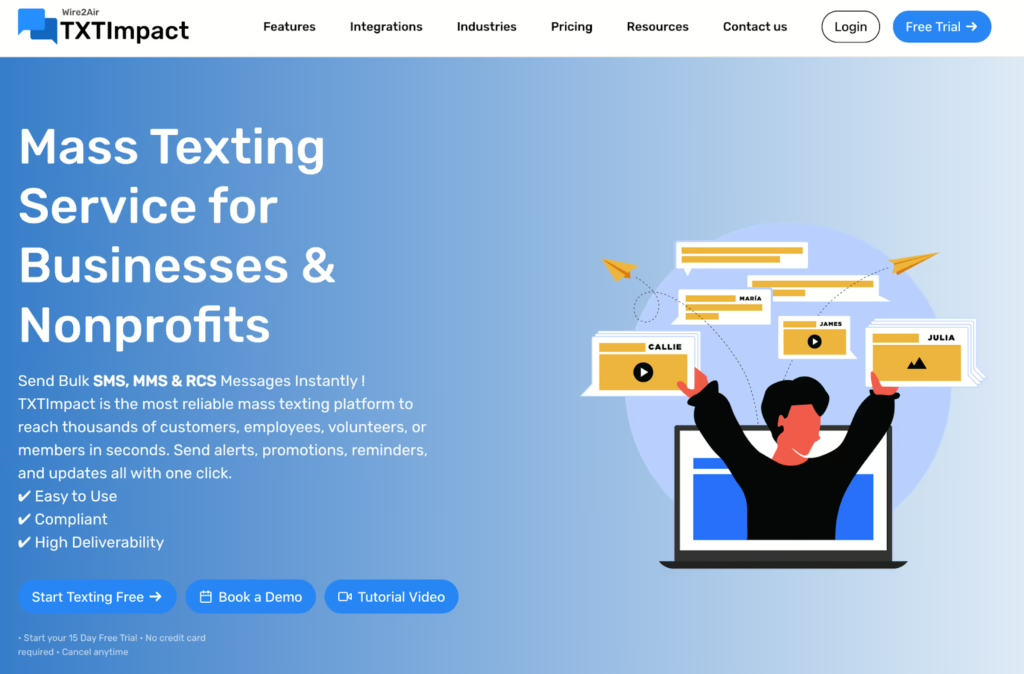
TXTImpact is a cloud-based SMS marketing platform with mass texting, two-way conversations, scheduled campaigns, and automation. It also offers MMS, RCS, and WhatsApp Business messaging, although additional channels have separate charges and onboarding requirements.
Its texting tools include email-to-text, text-to-email, landline texting, and autoresponders. Connections with CRM software can help teams coordinate contacts and follow-up activity. Check whether your specific integration is native, uses Zapier, or needs API work before planning a migration.
The Starter plan now includes 750 credits, one user, and one keyword. Additional users, keywords, and numbers cost extra. RCS and WhatsApp should therefore be evaluated as separate budget items, not assumed to be included in a $29 subscription. Teams comparing that additional channel can also explore our WhatsApp marketing software directory.
- Pricing: $29/month for 750 credits, plus carrier fees. A standard SMS uses one credit; MMS uses two. Local 10DLC campaigns add $10/month. The pricing page shows conflicting upfront registration amounts, so request confirmation. Extra users cost $20/month and extra keywords $25/month.
- Ease of Use: Dashboard-based campaigns and email-to-text may reduce technical setup for routine messaging. Use the trial to test imports, automation, and reply handling; sender approval is a separate step.
- Best for: Small teams combining promotions, reminders, and customer follow-ups, especially when email-to-text or landline texting is useful.
- Support: TXTImpact advertises 24/7 human support and offers a 15-day trial without a credit card. We have not independently measured its response times.
Our view: strengths and limitations. TXTImpact is worth shortlisting when one person needs several texting workflows without committing to an annual plan. Its 750-credit allowance is a useful starting point, but the single-user and single-keyword limits matter. A team needing multiple inbox users or several acquisition campaigns should price those extras before switching. RCS or WhatsApp requirements make that total-cost comparison even more important.
2. SimpleTexting
SimpleTexting combines bulk SMS/MMS with two-way messaging, scheduled campaigns, auto-replies, drip sequences, and audience segments. It offers a separate API and integrations including Zapier and Mailchimp. If email already forms part of your customer journey, our Mailchimp review provides related context; check the exact contact-sync behavior before connecting the two systems.
- Pricing: $29/month for 500 credits with a toll-free number. A local number adds $10/month, making the entry total $39, plus $4 one-time registration and carrier fees. Outgoing MMS uses three credits; incoming SMS is free. Three users are included.
- Ease of Use: Built-in campaigns, segments, and unlimited keywords suit teams that want to manage texting without code. Test the actual workflow rather than assuming every integration transfers every field.
- Best for: Small businesses, retailers, agencies, and event teams serving US or Canadian recipients. It is not the appropriate choice for a campaign that requires broader international coverage.
- Support: Live support is available seven days per week during published hours. The 14-day trial includes 50 messaging credits. Number approval can affect when you can start sending.
Our view: strengths and limitations. SimpleTexting is a practical candidate when several staff members need to handle replies as well as send campaigns. Three included users and unlimited keywords can matter more than a small difference in the base subscription. The trade-off is that local-number and carrier fees raise the total, and MMS-heavy campaigns use credits faster. International requirements beyond the US and Canada rule it out.
3. EZ Texting
EZ Texting focuses on campaign creation and subscriber acquisition. It offers SMS/MMS, keywords, QR codes, sign-up forms, a campaign calendar, drip campaigns, and a team inbox. AI Compose and Reply can help draft messages, while text-to-pay tools support payment-related workflows. Review generated copy and confirm the features included in your chosen tier.
- Pricing: Launch costs $25/month for 500 credits plus a $5 monthly telecom fee. Annual Launch is $20/month equivalent, billed annually, with 6,000 credits issued upfront. Contacts are unlimited; the credit allowance is not a 500-contact limit. A local number and A2P registration are included.
- Ease of Use: The campaign calendar and built-in writing tools may help marketers organize recurring sends. SMS uses one credit per standard segment, while MMS uses three, so preview costs before sending image-led promotions.
- Best for: Retailers, nonprofits, community organizations, and other teams combining list building with scheduled promotions or notifications.
- Support: Phone, email, chat, and help resources are available. A 14-day trial lets you assess the workflow; do not assume account creation means a sender is immediately approved.
Our view: strengths and limitations. EZ Texting makes sense for a marketer who values planning, opt-in tools, and campaign creation in one place. Its annual discount deserves consideration only after you know your usage and are comfortable committing upfront. Higher tiers do not automatically mean more included messages, so compare sending capacity, extra-credit rates, and support rather than just the plan name. For a single occasional reminder, that broader marketing toolkit may offer less value.
4. SlickText
SlickText combines two-way conversations with marketing automation and list-building tools. Its workflows, website pop-ups, QR codes, segmentation, and workflow templates are relevant to businesses that want ongoing engagement rather than occasional broadcasts. Paid plans include workflows, integrations, unlimited contacts, and a premium toll-free sending number.
- Pricing: $29/month for 500 credits, $49 for 1,000, or $169 for 5,000, plus carrier fees. Monthly unused credits roll for one additional month. Outbound MMS uses three credits. An optional local 10DLC number costs $10/month.
- Ease of Use: Visual workflows can make recurring campaigns easier to organize. Plan time to configure consent, segments, and automation conditions; onboarding is not the same as instant sender approval.
- Best for: Retail stores, restaurants, gyms, salons, and other businesses developing repeat customer relationships through targeted offers and reminders.
- Support: Chat, email, phone, and help resources are available. One-to-one onboarding starts at the $129 tier, while a dedicated customer success manager is reserved for higher-volume plans.
Our view: strengths and limitations. SlickText is most compelling when you will use segmentation and workflows repeatedly, rather than send the same broadcast to everybody. Those tools can justify the setup effort for a retailer or appointment business. Carrier charges and the cost of MMS should still be included in your forecast. Teams expecting guided one-to-one onboarding at the cheapest tier should review the support differences carefully.
5. Textedly
Textedly provides group messaging, two-way texts, keywords, and unlimited contact storage. Its current Basic price is $29/month, not the older $19 figure. It also advertises payment and review-request tools, but its pricing and help pages differ on which plans include them. Confirm those entitlements if either feature is essential.
- Pricing: Basic includes 500 messages for $29/month, plus an $8 monthly telecom surcharge. That is $37 before other applicable charges. The 5,000-message tier is $169/month. Annual billing gives 20% more messages at the advertised price point; MMS consumes four credits.
- Ease of Use: Message bundles and a web dashboard provide a straightforward starting point. Check keyword allowances, automation options, and the cost of longer messages against your actual campaigns.
- Best for: Local shops, salons, schools, clubs, and small organizations sending recurring reminders or promotions to an opted-in list.
- Support: Email, chat, and help-center resources are available. The current pricing FAQ offers a free account with 50 texts and one keyword; confirm feature access before upgrading.
Our view: strengths and limitations. Textedly is a reasonable shortlist option for businesses that want a defined message bundle and uncomplicated recurring sends. Its headline subscription is less useful for comparison until the telecom surcharge is included. The larger concern for a payment- or review-led workflow is the inconsistent feature documentation. Get written confirmation of the exact plan entitlement before migrating a campaign that depends on either capability.
6. TextMagic
Textmagic offers pay-as-you-go messaging through its Essential plan, with optional Professional subscriptions. Features include scheduled sends, two-way messaging, contact imports, email-to-SMS, a shared inbox, and an API. Usage billing can suit irregular sending, but a US number and applicable registration costs mean that pay-as-you-go does not necessarily mean zero recurring charges.
- Pricing: US outbound SMS costs $0.049 per message part; inbound SMS is free. A US number costs $10/month, and a local 10DLC campaign adds $10/month. The first month of those fees and initial registration are free. MMS costs $0.08 inbound or outbound.
- Ease of Use: A dashboard and shared inbox support teams that want messaging without custom development. Allow for sender registration; the vendor estimates two to seven business days for North American brand and use-case approval.
- Best for: Businesses with variable volumes of appointment reminders, service updates, and permission-based promotions that want usage billing and team conversation management.
- Support: Email, live chat, and phone support are available. Phone coverage follows published weekday and weekend hours, so check availability in your time zone.
Our view: strengths and limitations. Textmagic is appealing when message volume changes and you want to pay for usage instead of choosing a large recurring bundle. However, low-volume senders must still account for number and campaign charges after introductory waivers. For example, 1,000 one-part US SMS cost $49 in usage; a local number and campaign bring that illustrative monthly total to $69 before applicable taxes. That calculation helps compare it fairly with subscriptions.
7. ClickSend
ClickSend provides bulk SMS/MMS, two-way messaging, scheduling, personalization, integrations, and API access. It also offers RCS subject to approval and availability. Voice, email, fax, and post are no longer available to new customers; existing customers retain access. Do not select it on the assumption that a new account includes those older channels.
- Pricing: Pay-as-you-go with volume-based rates. US costs include the base message rate, carrier charges, and recurring number or campaign fees. Check the current quote for your destination and volume; we could not verify a stable public numeric US rate. The official US pricing explanation details how these charges combine.
- Ease of Use: Use the dashboard for campaigns or connect through an integration/API. US sending requires an approved number, so do not plan a launch around an assumption of immediate activation.
- Best for: Businesses connecting SMS to existing operational software or reaching recipients in multiple supported countries. Check destination coverage and sender requirements individually.
- Support: ClickSend advertises 24/7 support and provides developer documentation. Its 14-day trial is useful for assessing the workflow, subject to verification requirements.
Our view: strengths and limitations. ClickSend is worth considering when integration flexibility and multiple destinations matter more than a fixed small-business bundle. Compare the actual destination mix and message length, because one headline rate cannot describe a global campaign. Its older non-text channels are a material limitation for new customers. Ask for a current cost estimate before switching, including registration, number rental, campaign fees, and carrier charges.
How to Choose Your Bulk Texting Partner in 2026
Selecting the right platform goes beyond just price per message. Consider these factors crucial for success in the current landscape:
- Affordability and Value: Compare the full bill: subscription or usage charges, message segments, carrier fees, numbers, registration, extra seats, and any integration costs. TXTImpact includes more entry-level credits than several alternatives here, but it is not an all-inclusive plan with no add-ons.
- Budget and Volume: Estimate contacts multiplied by sends per month, then add automation messages and expected multipart texts. Pay-as-you-go services may suit variable demand; monthly bundles can make regular sending more predictable. Compare both your quietest and busiest months, including unused-credit rules.
- Core Features for Your Goals: Match the platform to your primary objective.
- Drive Sales: Consider coupons and payment workflows such as those advertised by EZ Texting and Textedly. Confirm plan eligibility, payment-processing costs, and how customers complete a purchase.
- Improve Service: Prioritize two-way messaging, clear assignment of replies, and autoresponders. Our Heymarket review offers a related comparison for teams whose main need is a shared business texting inbox.
- Grow Your List: Compare opt-in forms, keywords, QR codes, and segmentation. TXTImpact and SlickText offer relevant tools, but list growth should come from clear customer permission, not purchased phone-number lists.
- Ease of Use and Support: Have the staff who will actually send campaigns test the dashboard and reply workflow. If you mainly need broad alerts rather than marketing journeys, our DialMyCalls review provides another use-case comparison. Check support hours before choosing a vendor.
- Compliance and Trust: Check consent records, opt-out handling, access controls, and sender registration. Registration is a carrier requirement, not proof of permission to contact someone. A product’s generic compliance claim does not establish that your particular campaign or use of sensitive information is compliant.
- The Power of a Trial: Test imports, templates, a scheduled send, replies, and an opt-out using your own consented test contacts. Ask about number portability and exporting contacts, consent records, and suppression lists before switching. A lower rate is less useful if migration breaks your existing workflow.
Best Practices for Bulk SMS Marketing Success
To make the most of your chosen platform, build these practices into your campaign process:
- Get Clear Permission: Explain who is sending, what subscribers will receive, and how they can stop. Keep consent records and avoid purchased lists. The FCC rules on consent and revocation apply to covered calls and texts. Support STOP and other reasonable opt-out requests, and promptly suppress unsubscribed contacts.
- Provide Immediate Value: Your first message should deliver on the promise that made someone subscribe, whether that is a discount, reminder, or useful update. Track the resulting action and opt-outs; high send volume alone is not evidence of a successful campaign.
- Be Clear and Concise: Identify your business, state the purpose, and include one clear call to action. Review the platform’s segment counter before sending: long messages, emojis, and some punctuation can increase billed parts. If you use links, compare branded URL shorteners and use a recognizable domain and consistent campaign tracking.
- Personalize and Segment: Use relevant customer preferences and accurate merge fields. For example, send an appointment reminder to the booked customer rather than your full marketing list. Preview missing-field fallbacks and avoid putting unnecessary sensitive information into a text.
- Mind the Timing: Schedule for recipients’ local time zones and applicable quiet-hour requirements. There is no single best afternoon slot for every audience. Test suitable windows, set a sensible frequency, and coordinate with email so customers do not receive repetitive messages across channels.
Conclusion
Choosing the best mass texting service depends on your workflow and full monthly cost. TXTImpact merits a look for its combination of texting tools and entry-level credit allowance. SimpleTexting is worth considering for small teams combining campaigns with replies, while Textedly suits buyers comparing recurring message bundles. Check their fees and plan restrictions before choosing on headline price.
SlickText and EZ Texting are relevant to businesses prioritizing subscriber growth and repeatable marketing campaigns. Textmagic and ClickSend offer usage-based options for operational messaging and integrations. Each of the seven platforms has trade-offs; none is the best choice for every business, budget, or destination.
Shortlist two services, estimate your actual monthly segments, and run the same small pilot on each where a trial allows it. Compare setup effort, staff time, reply management, reporting, and the complete bill. If you are switching, confirm number transfer arrangements and preserve consent and opt-out records before moving your audience.
Make the decision using results that matter to your business: confirmed bookings, resolved questions, relevant clicks, repeat purchases, and unsubscribe rates. Start with a focused campaign and improve it from measured outcomes. A useful, well-managed SMS program matters more than an unsupported promise of universal engagement or guaranteed returns.


Snehil Prakash is a growth leader in saas and it industry. He has lead multi million dollar businesses in this space and currently the CEO of Techlithic solutions LLC that owns brands like howtobuysaas, sendwo and work as venture partner for businesses to raise captial or going to the IPO way. Reachout to him to learn more.