

Manufacturers lose time and margin when product defects are caught too late, missed during manual inspection, or flagged only after rework costs have already increased. Traditional inspection methods can struggle with high line speeds, changing product conditions, lighting variation, and defect types that are difficult to define with fixed rules.
Enterprise computer vision solution development helps solve this by using deep learning models, industrial cameras, edge infrastructure, and production-system integrations to inspect products in real time. These systems can detect surface defects, missing components, assembly errors, packaging issues, and other quality problems before they move further down the line.
This article explains how computer vision detects manufacturing defects, which use cases are already working at production scale, how edge and cloud inference compare, what ROI manufacturers can expect, where projects fail, and what a production-ready computer vision system should include.
What Is Enterprise Computer Vision Solution Development for Manufacturing Defect Detection?
Enterprise computer vision solution development for manufacturing defect detection is the design, training, deployment, and ongoing operation of custom deep learning systems. These systems are trained on a manufacturer’s specific products, defect classes, camera setup, lighting conditions, and production environment, then used to inspect items on a live line and trigger pass, fail, or rework decisions in real time.
The generational shift matters. Legacy machine vision was rule-based and rigid, while deep learning computer vision is trained by example and can adapt better to product variation.
- Manual inspection relies on human operators. Accuracy often declines over long shifts, throughput is limited, and labor costs continue to scale with production volume.
- Traditional rule-based machine vision can deliver high accuracy on predefined defect types, but it often struggles when lighting, angle, product geometry, or defect appearance changes. Each new defect class may require reprogramming.
- Deep learning computer vision can reach high accuracy on trained categories, improve with more labeled data, learn new defect patterns from examples, and run at milliseconds per frame across multiple camera feeds.
How Does Computer Vision Actually Detect Product Defects on a Live Production Line?
Here is what actually happens between a part arriving on the conveyor and a pass/fail decision reaching the PLC.
The Five-Layer Stack

- Image capture hardware. Industrial cameras (line-scan for continuous materials, area-scan for discrete parts, 3D for depth-sensitive defects, hyperspectral for material composition, thermal for hot-process inspection), paired with lighting (backlit, coaxial, dome, structured light) and lens optics. A weakness here propagates through the entire stack. Inadequate lighting produces images the AI model cannot learn from, per iFactory’s manufacturing guide.
- Object detection models. Deep learning frameworks like YOLO variants, Faster R-CNN, SSD, and Mask R-CNN identify defect locations and classify defect types in real time. Documented benchmarks show why YOLO dominates: a YOLO/CNN model for PCB defect detection hit 98.79% accuracy, YOLO-pdd reached 98.9% mAP, YOLO with attention on FPGA reached 99.2% accuracy at just 10W power draw, and DEMA-YOLO clocks inference speeds up to 134.2 FPS across PCB, NEU-DET, and wafer-map benchmarks.
- Anomaly detection and unsupervised learning. For defect classes with few labeled examples, unsupervised models such as autoencoders, Isolation Forest, and LSTM networks flag deviations from a learned “normal” distribution. A hybrid LSTM-CNN model reached 97.3% accuracy with a 1.9% false positive rate and 120ms detection latency in industrial IoT anomaly detection.
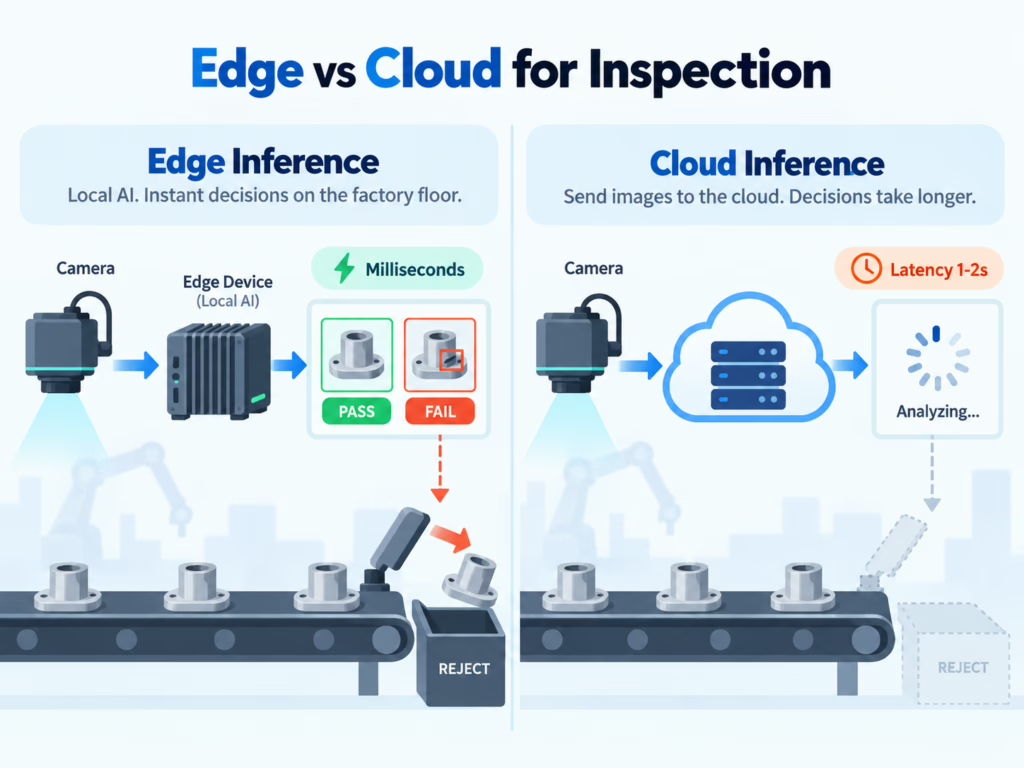
- Edge compute infrastructure. NVIDIA Jetson modules, Google Coral accelerators, FPGA boards, or industrial edge PCs run inference next to the camera. Edge inference returns decisions in single-digit milliseconds. According to Overview.ai, a cloud round trip adds 1 to 2 seconds of variable latency. On a high-speed line running 200 parts per minute, where the decision budget is around 300 milliseconds per part, cloud simply does not fit.
- MES, SCADA, and PLC integration. Native support for industrial protocols (EtherNet/IP, PROFINET, Modbus TCP, OPC-UA, MTConnect, ISA-95) is required so the inspection decision lands directly in the PLC and control logic.
The anchor telemetry on the Azumo side: Edge AI models on assembly line cameras detect micro-defects like scratches and misalignments at 500 units per minute. That is the throughput that becomes possible when the five layers work together as a system, not as isolated components.
What Types of Manufacturing Defects Can Computer Vision Detect at Line Speed?
The use cases are already deployed at scale across almost every heavy manufacturing vertical, not theoretical.

Automotive. Paint defects, weld quality, gap/flush analysis, assembly completeness verification, stud placement. According to iFactory, BMW achieved 37% defect reduction with AI vision across production lines. AI vision systems detect 0.2mm surface anomalies at 98.7% accuracy, inspecting 100% of production at 240 parts per minute, cutting scrap from 4.2% to 0.8% across validated automotive plants.
Electronics and semiconductors. Solder joint inspection, missing components, tombstoning, bridging, wafer defects. PCB defect detection is the most benchmarked use case in academic literature, with YOLO-based models routinely exceeding 98% accuracy.
Pharmaceuticals. Pill shape consistency, blister pack inspection, vial crack detection, serialization verification. According to BuildMVPFast, pharmaceutical facilities using AI inspection saw 64% fewer quality-related recalls. AI Advisory Practice documents 99.5% detection sensitivity on visible surface defects at 1,200 units per minute.
Steel and metals. Cracks, scale pits, roll marks, scratches, coating voids, inclusions. AI surface inspection saves $3M to $12M annually in steel mills where 2 to 5% of production typically downgrades, per iFactory.
Food and beverage. Fill level verification, seal integrity, foreign object detection, label accuracy. According to Capella Solutions, PepsiCo reduced missed package defects by up to 50% via computer vision on packaging lines, and L’Oréal decreased defects by 60% across 20 quality checkpoints on assembly lines.
Solar and renewables. According to GM Insights, Goldi Solar reduced defect rates from the 8 to 10% industry standard to below 2% using computer vision quality control at India’s first AI-integrated solar manufacturing plant, opened in March 2025.
Won’t every vertical need a different model? Yes, and that is exactly why enterprise computer vision solution development is the right frame, not a plug-and-play SaaS purchase. Each vertical has different lighting requirements, product geometries, defect taxonomies, and integration constraints. A specialist team that has already built across multiple verticals moves faster than a horizontal vendor forcing your line into their model.
How to Decide Between Edge and Cloud Inference for Defect Detection
The single most consequential architecture decision in enterprise computer vision solution development for manufacturing is where inference runs. Most vendors gloss over it. Get it wrong, and either latency kills the use case or bandwidth costs kill the business case.
The operating principle is direct: the inspection decision belongs at the edge. The cloud is for the analytics layer, not the per-part pass/fail call.
Edge inference latency runs in single-digit milliseconds because the AI runs on the camera itself, on an on-device GPU (NVIDIA Jetson, Coral, FPGA, industrial edge PC). Cloud round-trip latency, per Overview.ai, runs 1 to 2 seconds of variable delay because the image travels to a data center, gets processed, and travels back.
Do the line-speed math. A production line running 200 parts per minute gives you a roughly 300ms decision budget per part. Cloud does not fit. A line running at Azumo’s stated 500 units per minute gives you a 120ms budget. Only edge inference works. And on air-gapped OT networks, which describes most regulated manufacturing environments, cloud inference is not an option at all.
According to iFactory’s edge vs. cloud analysis, camera-based defect detection at line speed requires sub-50ms inference. Cloud round-trip latency makes this category impossible regardless of bandwidth. Edge GPUs process frames locally and trigger reject mechanisms before the part leaves the inspection station.
The right split is edge for inference, cloud for training, retraining, monitoring, and cross-plant analytics.
Isn’t edge deployment too expensive because of the per-camera hardware cost? It looks that way on the CapEx line. But according to TechyPulse, most facilities running high-speed lines recover the upfront hardware cost within the first year through reduced downtime, fewer missed items, and eliminated ongoing bandwidth and cloud compute costs that scale with camera count. On regulated or air-gapped lines, the “cheaper” cloud option is not an option at all.
What Is the True ROI of a Computer Vision Defect Detection System?
The ROI is not theoretical anymore. The data now comes from production deployments, not pilot programs.
Start with the baselines. According to Process Genius, citing the American Society for Quality, Cost of Poor Quality reaches 15 to 20% of total sales revenue in some industries. For a $10M manufacturer with a typical 20% COPQ, reducing quality costs by 25% saves $500K annually. The same source cites Siemens data showing the average cost of a single hour of unplanned downtime in manufacturing can exceed $250,000.
Now the payback math. BuildMVPFast reports average payback across implementations runs 8 to 14 months, with high-volume applications often breaking even in under 6 months. Typical mid-size implementations save $100,000 to $300,000 annually in labor alone. Scrap costs drop 15 to 20%. Automotive defect escape rates fall by up to 83%.

The specific manufacturing outcomes on the ground:
- BMW: over $1M per year saved by AI stud correction laser alone, with up to 60% defect reduction in some cases
- PepsiCo: 50% reduction in missed package defects
- L’Oréal: 60% defect reduction across 20 quality checkpoints
- Automotive Tier-1 suppliers: $45,000 per truckload avoided in expedited rework plus OEM penalty fees
- Steel mills: $3M to $12M per year in surface inspection savings
- Goldi Solar: defect rate from 8 to 10% down to below 2%
The macro anchor from Bain, cited in BuildMVPFast: 20 cents of every dollar spent in manufacturing is wasted, roughly $8 trillion globally. That is the pool computer vision defect detection is beginning to drain.
Won’t false positives eat all my labor savings by forcing manual reviews? It can. A plant that nails latency but ignores false-positive rates will still bleed labor hours to manual overrides. The fix is architectural: per-part confidence scoring, continuous retraining loops from operator overrides, and hybrid model routing (a fast general model for screening, a slower specialized model for validation on flagged items). Azumo’s NGL industrial engagement is direct evidence of this working in production: 70% false alarm reduction and 40% improvement in operator response times.
Where Enterprise Computer Vision Solution Development Fails (And What Buyers Get Wrong)
Even the right architecture fails for the wrong buyer, and the failure modes are predictable.
Skipping data preparation. Enterprise computer vision deployments that hit production accuracy targets typically spend 60% of their effort on data preparation and environmental engineering, and 40% on model development, per AI Advisory Practice. Organizations that invert this ratio rarely achieve sustained accuracy above 92% in live conditions. Data labeling costs range from $0.02 to $3.00+ per image, with QA and rework adding 20 to 40% to project costs, per Azumo’s computer vision service page.
Ignoring environmental variance. Vision systems struggle in poor lighting, complex backgrounds, and real-world conditions that differ from training data. Preprocessing techniques like OTSU binarization and denoising, along with dynamic augmentation for lighting, orientation, and background noise, are non-optional. This is exactly the discipline Azumo applied in the Centegix engagement to make the model robust on real-world images.
The false-positive tax. Operator override data is training data, not a nuisance to suppress. It is a feedback loop to feed back into model retraining. Facilities that treat every override as noise get worse over time, not better.
Skipping edge/cloud architecture up front. Getting this wrong means either unacceptable latency for real-time use cases or bandwidth and connectivity costs that undermine the business case.
The notebook problem. A Jupyter notebook with impressive accuracy metrics in a test environment is not a production system. It cannot be deployed, monitored, updated when performance drifts, or audited when a regulator asks why it produced a specific output. A vendor that hands off a notebook has demonstrated the model works. They have not demonstrated it can run.
No integration plan for MES/SCADA/PLC. When AI vision runs in parallel with the existing quality workflow instead of being embedded in the MES and PLC where reject decisions actually execute, adoption stays low and operator overrides multiply. Azumo’s manufacturing practice ships with OPC UA, Modbus TCP, MTConnect, and ISA-95 support as standard.
Shouldn’t the vendor identify and fix these problems? Partially. A vendor with real production experience pushes back on a vague brief, flags data gaps, and insists on an integration plan in discovery. That pushback is itself a selection signal. But ultimately the buyer owns the data, the workflow, and the KPIs. A vendor can flag. Only the buyer can fix.
What Enterprise Computer Vision Solution Development Looks Like for Manufacturers
Enterprise computer vision solution development for manufacturing is not just model training. A production-ready system needs the right camera setup, labeled defect data, edge or cloud architecture, integration with production systems, and a monitoring process that keeps accuracy stable after launch.
A strong manufacturing computer vision engagement usually includes:
- Discovery and KPI definition: The manufacturer should define the target defect types, current defect escape rate, scrap rate, rework cost, inspection throughput, and the improvement target. Without a clear baseline, it is difficult to prove ROI after deployment.
- Image and video data preparation: The system needs representative production data from the actual line, including acceptable products, known defect classes, lighting variation, camera angles, product orientations, and edge cases. Synthetic data and augmentation can help when real defect examples are limited, but they should not replace production validation.
- Model development and benchmarking: Defect detection may use CNNs, YOLO-family object detection models, segmentation models, or Vision Transformers depending on the task. The best approach should be selected through benchmarking, not assumptions, because speed, accuracy, and false-positive rates matter differently across production lines.
- Edge versus cloud architecture: Manufacturers need to decide where inference should run. Edge deployment is often preferred for live inspection because it reduces latency, bandwidth costs, and dependency on network stability. Cloud processing may still be useful for centralized analytics, retraining, and long-term model monitoring.
- MES, SCADA, PLC, and ERP integration: Detection results need to connect with the systems that already run the production floor. A defect alert should be able to trigger pass, fail, rework, escalation, reporting, or maintenance workflows through tools such as MES, SCADA, PLC interfaces, quality management systems, or ERP platforms.
- False-positive and false-negative control: A technically accurate model can still fail operationally if it creates too many false alarms or misses critical defects. Production systems need confidence thresholds, human review paths, exception handling, and feedback loops from operators.
- Production floor testing: Models should be validated under real operating conditions before full rollout. Testing should include line speed, lighting shifts, product variation, vibration, camera placement, and operator workflows.
- Continuous monitoring and retraining: Defect patterns, materials, suppliers, packaging, lighting, and production equipment can change over time. The system should track accuracy, drift, false alarms, operator overrides, and model performance by defect class so retraining can happen when needed.
FAQs
What is enterprise computer vision solution development for manufacturing?
The design, training, deployment, and ongoing operation of custom deep learning systems that inspect products on a live production line and trigger pass/fail/rework decisions in real time.
How accurate is computer vision at detecting manufacturing defects?
Modern deep learning defect detection systems routinely exceed 98% accuracy on trained defect classes. YOLO/CNN for PCB defects hits 98.79%, YOLO-pdd reaches 98.9% mAP, and specialized FPGA-deployed YOLO reaches 99.2%.
How fast can AI vision systems inspect products at line speed?
Edge-deployed models deliver decisions in single-digit milliseconds. Azumo’s own edge AI detects micro-defects at 500 units per minute, and documented pharmaceutical systems reach 99.5% detection sensitivity at 1,200 units per minute.
What’s the difference between traditional machine vision and AI-based computer vision?
Traditional machine vision uses fixed rule-based algorithms that break when conditions vary. Deep learning computer vision is trained on your specific images and learns new patterns from examples without rule changes, delivering 90%+ accuracy on trained categories that improves with more labeled data.
Should manufacturers run computer vision inspection at the edge or in the cloud?
The inspection decision belongs at the edge. Cloud round-trip latency of 1 to 2 seconds is incompatible with line-speed decision budgets of 100 to 300ms per part. Use cloud for training, retraining, and cross-plant analytics.
How long does it take to deploy a computer vision defect detection system?
A fixed-cost proof of concept can be delivered in 4 to 12 weeks depending on data readiness and integration complexity. Full production rollout with MES/PLC integration typically takes 4 to 9 months, with average payback of 8 to 14 months.


Snehil Prakash is a growth leader in saas and it industry. He has lead multi million dollar businesses in this space and currently the CEO of Techlithic solutions LLC that owns brands like howtobuysaas, sendwo and work as venture partner for businesses to raise captial or going to the IPO way. Reachout to him to learn more.