

Disclaimer: This is a promotional blog and the companies mentioned in this blog have paid us to get mentioned. Please do your due deligience before opting them. Howtobuysaas is not responsible for any activity beyond this.
UK SaaS companies raised over £7 billion in funding in 2025. That sounds like good news, and it is but it also means more products are competing for the same users, and there’s less patience for a slow, buggy, or confusing first release. If your product doesn’t work well early on, people won’t wait around for version two.
Here’s the part most founders don’t expect: when a SaaS build goes wrong, it’s rarely because the developers couldn’t code. It’s because the wrong partner got picked in the first place, usually in a rush, usually based on price alone, without anyone asking the harder question of what happens after the contract is signed and the money starts moving.
This guide walks through the 12 things worth checking before you hire anyone, based on the ways these projects actually go wrong in practice.
Quick answer: Before you hire a SaaS development company in the UK, check for a real discovery process, an in-house engineering team (not rotating freelancers), full-lifecycle SaaS development services, a transparent way of working while the build is happening, genuine experience with SaaS platform development, evidence you can independently verify, and a clear plan for what happens after launch not just before it.
1. A Discovery Process That Happens Before the Quote, Not Instead of It
Here’s a simple test: if a company can give you a fixed price and a start date after one phone call, be cautious. That’s usually a sign they haven’t asked the questions that actually determine cost who your users are, how you plan to make money, or why an earlier attempt at this idea (if there was one) didn’t work out.
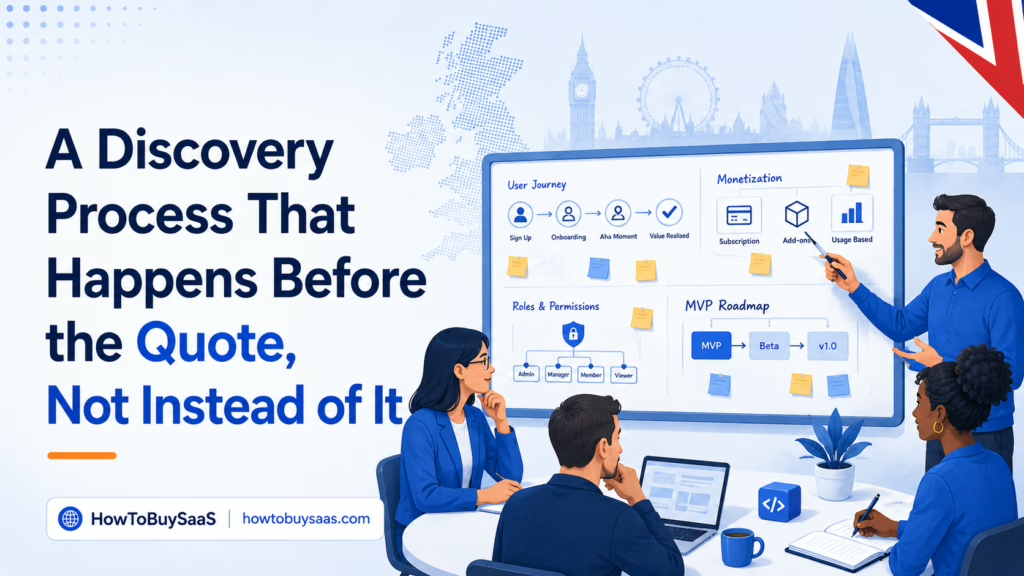
A proper discovery phase takes time, and it should answer three things clearly: what single action a new user needs to complete to understand the value of your product in their first few minutes, how accounts and permissions need to work (can one company have multiple logins with different access levels, for example), and what you’re actually charging for a seat per user, usage per month, or something else entirely. Skip this step to save time now, and you’ll usually pay for it twice: once for the first version, and again to rebuild the parts that were guessed instead of planned.
2. An In-House Engineering Team, Not a Rotating Cast of Freelancers
SaaS products aren’t built once and left alone. They get worked on for years, and the decisions made in the first few months how the database is structured, how the code is organised still shape everything that gets built on top of them much later.
That’s why it matters who’s actually writing your code, and whether they’ll still be around in six months to explain why they built it that way. Ask directly. A genuine SaaS development company with an in-house team can answer without hesitating. A company that pulls in contractors from a marketplace for each project usually can’t, and you’ll notice the cost of that every time someone new joins and has to spend two weeks just figuring out how the existing code works before they can add anything to it.
3. Full-Lifecycle SaaS Development Services, Not Just a Build Shop
There’s a real difference between “we’ll write the code you send us” and “we provide SaaS development services.” The second one is much bigger. It covers the strategy work before anything gets built, the design of what users will actually see and click, the underlying technical architecture, the engineering itself, testing, and, importantly support in the weeks after launch, not just the moment the first version ships.
If a company’s pitch stops at “send us a spec and we’ll build it,” that’s a coding shop, not a partner who’ll help you think the product through. This distinction matters most exactly when your original plan turns out to be slightly wrong which, for a first SaaS release, it almost always is in some way. You want a partner who expects that and has a way to handle it, not one who just builds whatever was written down on day one.
4. A Transparent Process, Not a Black Box Until Delivery Day

A lot of frustration on software projects has nothing to do with bad code. It comes from not knowing what’s actually happening between the kickoff call and the day something finally gets shown to you.
Before signing anything, ask how the team actually works day to day. You want to know how progress gets tracked, how often you’ll see something real (not just a status update), and what happens if the scope needs to change halfway through, because it usually does at least a little. A partner with a proper process will typically be able to point to things like short, regular development cycles (often called sprints) with a working demo at the end of each one, a named person managing the project rather than a rotating cast of emails, clearly agreed milestones, and a shared tool Jira, Slack, or Azure DevOps are common ones where you can see what’s being worked on without having to ask.
None of this guarantees a good product on its own. But a team that’s vague about how they communicate is often just as vague about how they build, and the two tend to go together.
5. Real SaaS Platform Development Experience, Not Just App Experience
Building a mobile app and building a SaaS platform sound similar, but they’re genuinely different jobs. SaaS platform development means designing a system that can safely serve many different customers at once this is called “multi-tenant” architecture, and it simply means each customer’s data stays private and separate even though everyone is using the same
underlying system. It also means handling subscription billing properly, building in the ability to automatically add more computing power as more users sign up (known as auto-scaling), and keeping detailed records of who did what, which larger customers will eventually ask to see.
It’s worth going a layer deeper here, because this is where weaker teams tend to cut corners. Ask what a prospective partner actually uses to run and manage the platform day to day cloud providers like AWS, Microsoft Azure, or Google Cloud are the standard choice, and tools like Docker and Kubernetes are what most modern SaaS platforms use to package and run the software reliably across many servers at once. Ask, too, whether new code gets tested and released automatically through what’s called a CI/CD pipeline, rather than being pushed live by hand automated release processes catch far more mistakes before they reach your customers. And ask whether the system is built from smaller, independent services (often called microservices) that can be updated one at a time, rather than one giant application where a small change risks breaking everything else.
A good way to test all of this in conversation: ask a prospective partner to explain, in plain terms, how they’d keep one customer’s data completely separate from another’s on shared infrastructure. If the answer is vague, that vagueness tends to turn into a very expensive rebuild about six months after launch, once real customers and their data are already on the system.
6. Clear Thinking on Subscription Billing and Recurring Revenue
A SaaS business only works if people keep paying month after month, which means how billing works isn’t a small technical detail you leave until the end it’s a core part of the product itself. Ask a prospective partner how they’d handle a customer upgrading their plan, the difference between charging per seat versus charging based on usage, what happens when someone’s card payment fails (this process is called “dunning,” and doing it badly is a quiet but common way SaaS companies lose paying customers), and how a free trial should smoothly convert into a paid plan.
Teams who treat billing as “we’ll just plug in Stripe at the end” tend to build systems that are painful to change later. That becomes a real problem the moment you realise and most founders do that your first guess at pricing wasn’t quite right.
7. Compliance and Security Built In, Not Bolted On

In the UK, GDPR applies to almost everyone handling customer data, and certain industries have extra rules stacked on top of that, fintech companies need to think about FCA and PSD2 requirements, for example, and anything touching health data needs to be handled with the same care as HIPAA requires in the US. Trying to add proper compliance into a system after it’s already built is one of the most common reasons SaaS budgets end up far higher than originally planned.
Security deserves its own checklist, not just a general promise. Worth asking about directly: whether customer data is encrypted both when it’s stored and when it’s moving between systems, how logins and permissions are handled so people can only see and do what they’re supposed to, whether the APIs connecting different parts of the system are built securely by default, whether the team runs regular vulnerability testing rather than a one-off check before launch, and what the actual backup and disaster recovery plan looks like if something does go wrong.
“We follow best practices” doesn’t tell you much on its own. “Here’s a regulated system we built, and here’s specifically how we structured the data to stay compliant” tells you a lot more.
8. Engagement Models That Actually Fit Your Stage
A startup trying to prove an unproven idea works, a scale-up dealing with its first wave of real growth, and an established business trying to modernise an old, creaking system are three very different situations. They shouldn’t all get offered the same fixed-scope contract with a different company name on the top.
Look for a partner who can genuinely offer different ways of working, full product ownership when you’re still validating an early idea, an embedded dedicated team once you have traction and need to move quickly, or focused modernisation support if you’re improving something that already exists. If every option a vendor offers looks basically the same regardless of your situation, that’s often a sign they haven’t actually worked across enough different company stages to understand why the difference matters.
9. Honest Numbers on Cost and Timeline
SaaS product development services in the UK are usually priced in stages rather than as one single number, and that’s a good thing, it means you’re paying for what you actually need at each point, rather than guessing upfront. As a rough guide, discovery typically costs somewhere between £8,000 and £20,000, a proof of concept runs roughly £15,000 to £40,000, and a full MVP build typically falls between £40,000 and £120,000. The final number is shaped far more by things like how many other systems you need to connect to, what compliance rules apply, and how complex your multi-tenant setup needs to be, not simply by an hourly rate.
A partner who’s happy to walk you through what drives the cost at each stage is being genuinely useful. A partner who gives you one flat number for the whole project before any discovery has even happened usually isn’t because at that point, they can’t actually know yet.
10. AI Capability That’s Native to the Product, Not Bolted On
Heading into 2026, most UK SaaS buyers expect some level of automation as a standard part of the product, not as an extra feature you pay more for later. There’s a meaningful difference between AI that’s designed into a workflow from the very start, an automated support tool that reads incoming tickets and drafts a response, for example, and AI that’s added afterward as a surface-level feature nobody really asked for and few people end up using.
Even if you’re not planning to add AI features on day one, it’s worth checking how ready the underlying system would be if you changed your mind later. A platform built with modular, API-first architecture, meaning the different parts of the system talk to each other through clearly defined connections rather than being tangled together, can usually have AI features added without a redesign. A platform that wasn’t built this way often needs significant rework first.
Ask what AI features a prospective partner has actually built and shipped for real customers, and whether those features were tested with real usage data or simply added because someone thought the pitch deck needed an “AI” slide. How honestly they answer that question tells you a lot about how they’ll approach the rest of your product too.
11. A Plan for What Happens After Launch
Launch day is, ironically, the easiest part of a SaaS build to plan for, and the part most companies under-resource once it’s done. The real work starts the day after: the bug reports, the feature requests that contradict each other, the drop-off in usage nobody predicted. None of that shows up until real people start using the product.
A genuine long-term SaaS development partner should be able to tell you, specifically, what support looks like after launch, how often they review analytics with you, how bugs get triaged and fixed, and what happens if you ask for a new feature that doesn’t fit neatly into the existing setup. It’s also worth asking a longer-range question: will this team still be a sensible partner for you in three or five years, once you’re adding markets, new integrations, or a second product line? If the honest answer to any of this is “we’ll figure that out when it comes up,” it’s worth budgeting for a second vendor down the line, because you’ll likely need one.
Frequently Asked Questions
What should I look for when hiring a SaaS development company in the UK?
Look for a genuine discovery process, an in-house engineering team, full SaaS development services rather than coding-only delivery, a transparent way of working while the build is happening, real experience with multi-tenant platforms, compliance built in from the start, and evidence of past results you can check independently rather than marketing claims alone.
How much do SaaS development services cost in the UK?
Costs are usually staged rather than a single flat fee: roughly £8,000–£20,000 for discovery,
£15,000–£40,000 for a proof of concept, and £40,000–£120,000 for an MVP. The final total depends mostly on integrations, compliance needs, and how complex the architecture needs to be.
What’s the difference between a SaaS development company and a freelance developer? A SaaS development company brings discovery, architecture planning, quality testing, and delivery structure on top of the actual coding. A freelance developer typically provides coding capacity alone, without necessarily making the product-level decisions that determine whether the system can grow later without being rebuilt.
Do I need SaaS platform development experience specifically, or is general app development experience enough?
Platform-specific experience genuinely matters here. Serving multiple customers safely from one system, handling subscription billing properly, and scaling automatically under real load are different engineering problems from building a single app for one set of users, and teams without that specific experience often end up rebuilding parts of the product once real customers arrive.
What does a transparent development process actually look like?
In practice, it usually means short development cycles with a working demo at the end of each one, a named project manager rather than a rotating point of contact, agreed milestones you can track, and a shared tool where you can see progress without having to chase for updates.
How long does SaaS product development take from idea to launch?
Discovery and proof-of-concept work usually take four to eight weeks combined. A full MVP build typically takes three to six months depending on how much scope is involved, and the product keeps evolving after launch based on how real users actually behave.
Should I choose a SaaS development agency or a dedicated product engineering partner?
An agency generally suits well-defined work where the plan is already clear. A dedicated product engineering partner is the better choice when discovery, architecture, and decisions about AI still need to be worked through, which describes most founders building a SaaS product for the first time.
What’s a realistic red flag that means I should walk away from a vendor?
Be cautious of anyone who gives you a fixed price with no real discovery conversation, can’t clearly explain who will actually be writing your code, stays vague about how they communicate during the project, or answers technical questions about compliance and data security in general terms rather than with specific examples from past work.
Is the cheapest SaaS development company ever the right choice?
Not usually, and it’s worth understanding why. The cheapest quote is often cheap because discovery, architecture planning, and compliance work have been skipped, not because the company is simply more efficient, and those skipped steps tend to resurface later as an expensive rebuild.


Snehil Prakash is a growth leader in saas and it industry. He has lead multi million dollar businesses in this space and currently the CEO of Techlithic solutions LLC that owns brands like howtobuysaas, sendwo and work as venture partner for businesses to raise captial or going to the IPO way. Reachout to him to learn more.