

Hiring on gut feel is expensive. So is promoting the wrong person because they interviewed well. Employee assessment tools exist to fix that one problem: replace guesswork with a score you can actually defend to your CFO. The good ones do this without adding a pile of admin work on top.
This list covers the employee assessment tools HR teams actually use in 2026, whether you’re screening candidates before an offer or running an employee skills assessment on people already on payroll. Pricing is what each vendor publishes, or what buyers report when it isn’t public.
1. ProProfs Quiz Maker: Best for Creating Quizzes & Assessments for HR Teams

ProProfs Quiz Maker is built for HR teams that need to run assessments without looping in IT. Pick from templates or build a test from scratch, add a scoring key, and send it out. Results land in a dashboard showing who passed, who’s borderline, and where a department is weak on a specific skill. It handles pre-hire screening, compliance checks, and ongoing employee skills assessment in one place, with timers, randomization, and clean report exports built in.
Pros
- Fast to set up; no IT ticket required
- Handles hiring screens and internal skills assessment in one tool
- Free plan available, so smaller teams can test it before committing
Cons
- Deeper analytics and branching logic take a bit of setup time to learn
- Best proctoring features are gated to higher tiers
Pricing: Free plan available. Paid plans start at $20/month on the Business tier, with better per-month rates on annual billing.
2. Helix: Best for Soft Skills Development in the Flow of Real Work
Helix is 5app’s award-winning AI-powered skills intelligence platform that gives HR and L&D teams a more objective way to assess and develop the soft skills employees demonstrate in their day-to-day work. Rather than relying on self-assessments, surveys or occasional manager observations, Helix analyses behavioural signals from real workplace conversations in Microsoft Teams, Zoom and Google Meet, providing scores and insights across skills such as communication, active listening, coaching, accountability and leadership.
Pros
- 90+ measurable soft skills, including custom and editable skill sets
- Assessment in the flow of real work for contextual, holistic skills insights
Cons
- Primarily designed for soft skills development, not technical skills
- Pricing is better suited to larger enterprises
Pricing: Custom, quote-based. Can be bundled with other 5app products.
3. TestGorilla: Best for Broad Skills Testing Across Roles
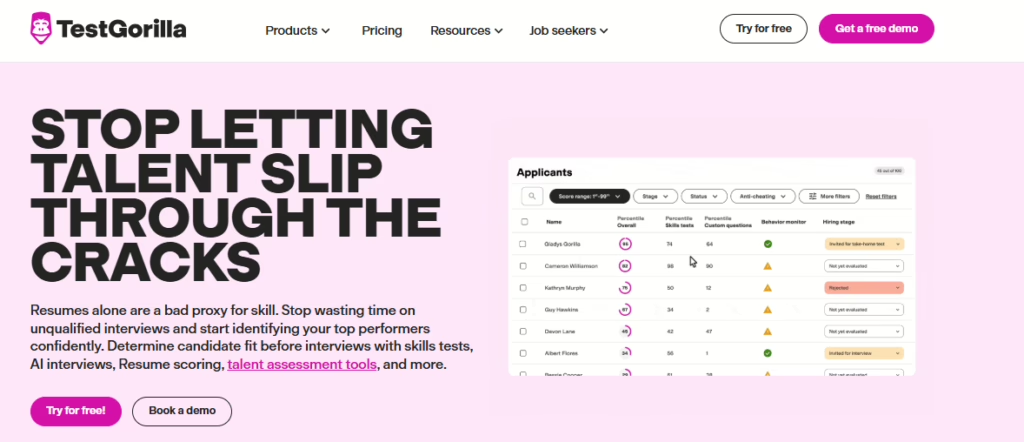
TestGorilla leans on breadth. Its test library covers cognitive ability, personality, coding, and role-specific skills, so one account can screen a support hire and a developer without switching platforms. It plugs into ATS platforms like Greenhouse and BambooHR too. The catch is credit-based pricing: every paid plan requires an annual commitment, and unused credits don’t roll over.
Pros
- Large, varied test library covering technical and soft skills
- Strong ATS integrations
- Anti-cheating features are genuinely solid
Cons
- No monthly billing option on paid plans; annual commitment only
- Jump from entry to mid-tier pricing is steep
Pricing: Free plan available. Core plan from $135/month (billed annually). Plus plan from $400/month (billed annually).
4. HackerRank: Best for Technical and Developer Skills Assessment

HackerRank exists for one specific job: assessing developers. Its coding challenges, real-time scoring, and plagiarism detection are built for technical hiring in a way generalist tools aren’t. Recruiters can run live coding interviews inside the platform or send take-home tests, with reporting that shows exactly where a candidate’s logic broke down. That specialization is also its limit: for personality or soft-skills assessment, look elsewhere.
Pros
- Purpose-built for technical hiring, with deep language support
- Strong plagiarism and anti-cheat detection
- Scoring is transparent enough to justify decisions to candidates
Cons
- Narrow use case; not built for non-technical assessment
- Pricing climbs fast once you need more than a handful of attempts a month
Pricing: No free plan. Starter plan from $165 to $199/month depending on billing term. Pro plan from $449/month.
5. Vervoe: Best for Work-Sample and Simulation-Based Testing
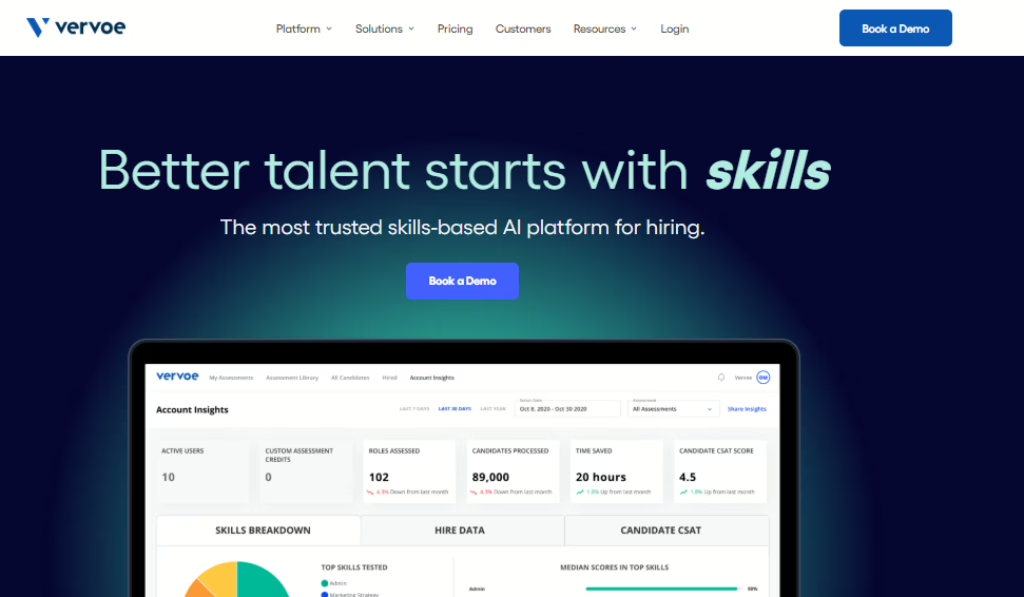
Vervoe’s pitch is simple: stop asking candidates to describe how they’d do the job and have them do it. Its simulations put people through realistic work tasks, then an AI grading layer ranks them on actual output, which works well for roles like copywriting or sales where skill is hard to capture in a multiple-choice test. Setup takes longer than a template-based tool, since you’re building simulations rather than picking from a stock library.
Pros
- Realistic, job-specific simulations instead of generic tests
- AI grading reduces manual review time
- Strong candidate experience, which helps completion rates
Cons
- Fewer native integrations than larger platforms
- Initial simulation setup takes more effort than template-based tools
Pricing: Pay & Go plan starts around $19/month. Professional and Enterprise plans are quoted after a demo.
6. Criteria Corp: Best for Validated Pre-Employment Testing

Criteria Corp is built around scientific validity. Its cognitive aptitude, personality, and emotional intelligence tests are the kind you’d cite if a hiring decision ever got legally challenged, which is why larger, more regulated employers lean on it. The tradeoff is that nothing about it is self-serve: pricing isn’t published, and getting a quote means a sales conversation. Reporting also assumes some familiarity with normed psychometric scores.
Pros
- Scientifically validated assessments, useful for defensibility
- Wide range of test types: cognitive, personality, risk, skills
Cons
- No published pricing; every quote requires a sales call
- Reports assume some familiarity with psychometric scoring
Pricing: Custom, quote-based. Published buyer reports put small-business annual contracts in the $5,000 to $10,000 range.
7. Mercer Mettl: Best for Large-Scale Campus and Bulk Hiring

As employee assessment software goes, Mercer Mettl is the tool HR teams reach for when they need to assess hundreds of candidates at once, like a campus hiring drive or a bulk lateral hire. Its question bank runs deep across aptitude, coding, and behavioral tests, with remote proctoring built in rather than bolted on. The credit-based pricing rewards high-volume use and penalizes infrequent use, so budget accordingly if your hiring is sporadic.
Pros
- Handles high-volume assessment cycles well
- Built-in proctoring and a deep question library
Cons
- Credit-based pricing punishes low, irregular usage
- Some buyers report friction with account reps at renewal time
Pricing: Custom, pay-per-use, or subscription-based on assessment volume.
8. The Predictive Index: Best for Behavioral and Team-Fit Assessment

The Predictive Index isn’t primarily a skills-testing tool; it’s a behavioral assessment that tells you how someone is wired to work, communicate, and make decisions. HR teams use it to round out a hiring decision after skills are confirmed, or to help managers understand why two capable people on the same team keep clashing. The assessment takes about six minutes with no right or wrong answers, which candidates find less stressful than a timed skills test. Buyers consistently describe it as expensive but worth it.
Pros
- Strong behavioral and team-fit insight, not just a pass/fail score
- Widely trusted for management and team-dynamics decisions
- Untimed, low-stress format for candidates
Cons
- Not a skills test; needs to be paired with one for full hiring coverage
- Pricing is a recurring complaint, especially for smaller or part-time workforces
Pricing: Custom, annual contracts. Third-party pricing trackers report typical starting points between $5,000 and $7,500/year, though PI doesn’t publish official rates.
9. iMocha: Best for Skills Gap Analysis Inside Existing Teams

iMocha is less about screening new hires and more about mapping the skills your current employees already have against what your roadmap needs. As employee assessment software goes, its skill-inference engine flags gaps at the individual and team level, useful if you’re planning internal mobility or upskilling budgets rather than external hiring. It also handles pre-employment testing well, with coding simulators for technical roles. Pricing isn’t published; expect to book a demo for a number.
Pros
- Strong for internal skills-gap mapping, not just pre-hire testing
- Project-based and coding simulations for technical depth
Cons
- No published pricing; requires a sales conversation to evaluate
- Ease of setup lags behind some lighter-weight competitors
Pricing: Custom, quote-based. Third-party estimates put entry pricing near $200/month.
10. Codility: Best for High-Volume Technical Hiring at Enterprise Scale

Codility is built for engineering teams hiring at volume, with a coding environment that mirrors a real IDE closely enough that developers don’t feel like they’re fighting the tool. Its plagiarism and integrity detection are aimed at enterprise pipelines where hundreds of candidates move through the same funnel every quarter. Pricing, like most enterprise platforms here, requires a sales conversation.
Pros
- IDE-like coding environment developers don’t resent
- Built for high-volume, enterprise technical hiring
Cons
- No self-serve pricing or plans
- Overkill for teams hiring outside of engineering roles
Pricing: Custom, quote-based only.
11. SHL: Best for Enterprise Psychometric and People Science Assessment

SHL has been in the assessment business since 1984, and its psychometric tests, situational judgment tests, and job simulations are the ones most likely to show up in a Fortune 500 hiring pipeline. It’s the deepest bench on this list for people-science rigor, covering everything from cognitive ability to values-based fit across dozens of industries. That depth comes with a heavier lift to deploy, built for organizations with an HR or talent-assessment specialist on staff rather than a lean team doing hiring on the side.
Pros
- Deep, research-backed assessment library
- Trusted at the enterprise and Fortune 500 scale
Cons
- Heavy implementation lift; not a same-day setup
- Pricing isn’t published anywhere; sales-led process only
Pricing: Custom, quote-based. No published pricing available.
Which Employee Assessment Tool Should You Actually Pick?
For one employee assessment software that covers hiring screens, compliance checks, and ongoing employee skills assessment without stitching three tools together, ProProfs Quiz Maker is the simplest starting point here. For purely technical hiring, HackerRank or Codility makes more sense. For behavior and team fit over hard skills, The Predictive Index fills that gap. Match the tool to the job, not the other way around.


Snehil Prakash is a growth leader in saas and it industry. He has lead multi million dollar businesses in this space and currently the CEO of Techlithic solutions LLC that owns brands like howtobuysaas, sendwo and work as venture partner for businesses to raise captial or going to the IPO way. Reachout to him to learn more.