

If you have lived through an enterprise AI launch, you already know the scene.
The dashboard is green. The steering committee says “go-live.” The invoice went out. Then Monday morning arrives, and the team opens the same spreadsheet they used last quarter.
You feel the gap instantly. They call it deployment. You call it what it really is: a pilot that never became part of the work. That gap is not unusual. BCG reported that 74% of companies struggle to achieve and scale value from AI, and McKinsey’s 2025 global survey found that most organizations are using AI, but many still have not embedded it deeply enough into workflows to realize material enterprise-level benefits.
That is the real AI pilot to production problem.
A pilot can impress a steering committee. It can prove a model is promising. It can even produce a slide that says the use case is “validated.” What it usually does not prove is that the system will survive live data, workflow friction, exception handling, adoption resistance, and CFO-level scrutiny once the tool lands in production. Google Cloud’s production monitoring guidance exists for exactly this reason: input data in production can drift away from training data, and training-serving skew can appear after deployment. Microsoft’s guidance makes the same point from the operations side: successful integration means embedding AI where work already happens, with monitoring, lifecycle management, and governance after deployment, not just technical launch.
So let’s call things by their right names.
A pilot tests promise. Production tests reality.
What a pilot actually proves
A healthy pilot matters. It reduces uncertainty. It helps teams learn fast. It can show whether the model can classify documents, predict demand, summarize contracts, or guide a planner.
But a pilot usually happens in a safer environment than real operations.
The data is cleaner. The users are friendlier. The edge cases are fewer. The workflow is simpler. The people involved are often power users who volunteered to try the tool, not the broader employee base that has to use it every day at speed. That distinction matters because high-performing AI organizations do more than deploy tools. McKinsey found that organizations seeing the greatest impact are far more likely to redesign workflows, embed AI into business processes, define human-validation processes, and track business KPIs instead of stopping at technical success.
This is where many enterprise teams get trapped.
They assume a successful pilot means the hard part is behind them. In reality, the hard part often starts right after the demo works.
Microsoft’s enterprise guidance is blunt on this: integrating AI into business operations is not just technical deployment. It requires placing AI in the apps and channels employees already use, running phased rollout plans, managing change, measuring actual business impact, and preventing technical debt and fragmentation after launch.
So if you are evaluating an AI pilot to production transition, ask a tougher question:
Did the pilot prove the model, or did it prove the operating system around the model?
If it only proved the model, you are not ready to celebrate yet.
Why the green dashboard can still hide a broken rollout
This is the part nobody likes to say out loud.
A green dashboard can be technically true and operationally misleading at the same time.
The tool may be live. Uptime may be excellent. Accuracy may still look acceptable in the abstract. But none of that guarantees people are using it, trusting it, or getting measurable value from it. McKinsey found that while many companies report use-case-level benefits, only 39% report any enterprise-level EBIT impact from AI. BCG has also argued that the biggest blockers to adoption are often people and process issues, not technology alone.
That is why rollout theater is so common.
They may say:
- “The system is live.”
- “The integration is complete.”
- “The users were trained.”
- “The KPI dashboard is stable.”
You may still find planners, analysts, coordinators, or operators quietly returning to the old spreadsheet, old inbox, old workflow, or old approval chain.
Why? Because the deployment did not win the daily habit.
BCG says AI only delivers impact when employees embrace it, and Microsoft says successful integration requires embedding AI into the tools people already use, because forcing context switching increases friction and reduces adoption. McKinsey’s 2025 work points in the same direction: redesigning workflows is one of the strongest contributors to meaningful business impact.
In plain English: if the AI adds clicks, adds uncertainty, adds manual review, or adds one more tab to a worker’s day, adoption stalls.
And once adoption stalls, value stalls with it.
Where enterprise AI deployments usually break
A practical way to think about the AI pilot to production gap is to stop treating it as one big failure and start treating it as a series of specific failure points. The client’s linked source frames those failure points as integration, exception handling, adoption, and value verification. That framing also lines up with broader enterprise guidance on workflow integration, governance, monitoring, and performance measurement.

Here is what that looks like in real operations:
Integration
The model worked on the extract. Production runs on live systems, messy inputs, shifting fields, and real handoffs. Google Cloud’s model monitoring documentation highlights exactly why production differs from the training environment: feature drift and training-serving skew can emerge once live data starts flowing.
Exception handling
Every AI system creates exceptions. Someone has to catch them. Someone has to own the queue. Someone has to respond within a real SLA. If nobody funds that work, the backlog becomes a hidden tax on the business. Microsoft’s governance and operating guidance emphasizes lifecycle management, monitoring, and operational control after deployment, not just launch-day delivery.
Adoption
The people who volunteer for a pilot are not the same as the full user base in production. BCG argues that design for adoption, employee involvement, visible leadership, and reduced workflow friction are central to scaling AI.
Value verification
This is the one that hurts the most. The business case promised cycle-time reduction, cost savings, higher forecast accuracy, or faster throughput. But six months later, nobody can prove whether the number actually moved. McKinsey found that tracking KPIs for AI solutions correlates with significant value creation, and Microsoft recommends defining and reporting business outcomes as part of AI operations.
If you are the operations lead, this is the takeaway:
You do not just need a go-live plan. You need a plan for the messy middle that comes after go-live.
Why a time-and-materials SOW often breaks in the messy middle
This is where the article becomes especially useful for buyers.
A standard time-and-materials contract is not evil. Sometimes it is practical. Sometimes it is the fastest way to get work moving. But by definition, a time-and-materials structure pays for labor hours and materials used. It does not automatically tie vendor economics to your production outcome. Federal acquisition rules describe time-and-materials contracts in exactly those terms, while performance incentives are designed to relate fee or profit to results achieved against specified targets. Performance-based service contracts are also expected to include measurable performance standards and a method for assessing performance.
That difference matters more than most teams admit.
If the SOW defines success as “design completed,” “integration delivered,” “testing passed,” or “go-live achieved,” a vendor can hit every contractual milestone and still leave you holding a tool that nobody uses and Finance cannot validate.
In other words, completion is not the same thing as outcome.
That is why the rough draft’s instinct is right: if your deployment SOW stops at the milestone, it can stop before the value appears. The commercial shape matters because the contract tells everyone what “done” really means. If the fee ends at go-live, attention often does too. If a meaningful part of the commercial structure survives into production verification, the delivery behavior changes.
You do not need a legal theory here. You need operational honesty.
Ask yourself one hard question:
What percentage of the vendor’s fee depends on a production outcome that Finance, or another named business owner, can actually verify?
If the answer is zero, you should at least understand the risk you are signing up for.
The eight questions to ask before signing a deployment SOW
If you want to pressure-test an enterprise AI deployment before it becomes your long-term cleanup job, put these eight questions on the table before signature. They synthesize the pressure points surfaced in the client source, plus broader guidance from Microsoft, Google Cloud, and performance-based contracting standards.
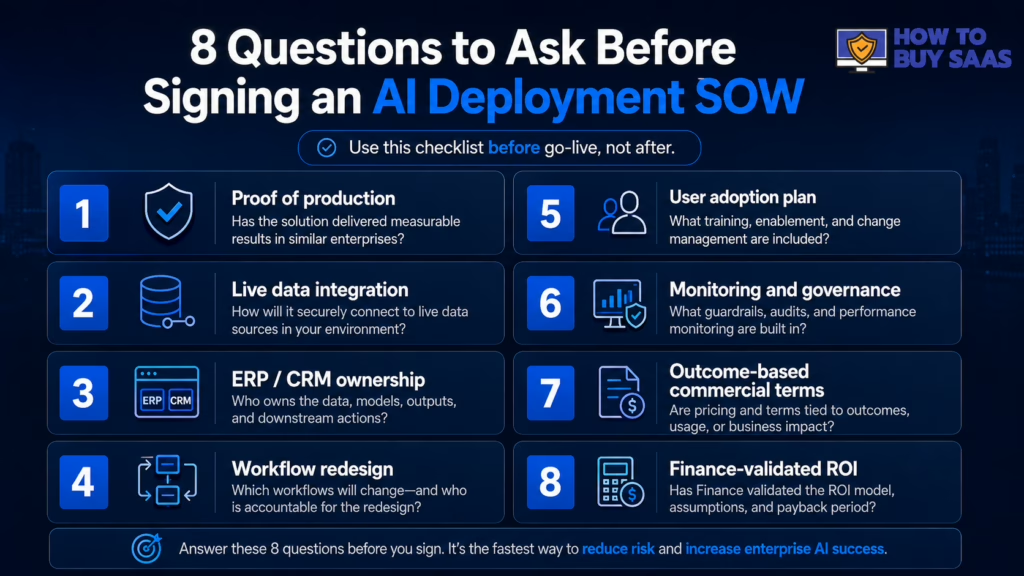
Ask these in writing:
- What has been tested against live production data, not just historical exports or sandbox data?
If production data behaves differently, the pilot did not test the whole system. - Who owns the exception queue on day 30, day 90, and day 180?
Name the team, the SLA, and the budget. - What exact business metric is this deployment supposed to move?
Not model accuracy. Not uptime. The business number. - Who signs off that the number moved?
Give that responsibility to a named business owner, ideally one trusted by Finance. - What adoption threshold defines “in production”?
Spell out the user group, usage rate, workflow, and time window. - How is the AI embedded into the tools people already use?
If users must jump across systems, friction goes up and adoption goes down. - Who is the named accountable person on the vendor side from kickoff through value verification?
Not the account team. A named owner. - What is the written remediation path if the promised metric does not verify?
Good SOWs do not just define success. They define what happens if reality pushes back.
These questions do two things at once.
First, they expose whether the deployment is built for production or just for show. Second, they force everyone to admit whether the outcome is operational, financial, or merely ceremonial.
That is a much better conversation to have before the SOW is signed than after the internal frustration starts.
What a stronger AI deployment plan looks like
A stronger AI pilot to production plan is not just “more governance” or “more training.” It is more specific than that.
It usually includes these traits:
- AI is embedded inside real workflows, not parked in a separate interface.
- Monitoring is set up for drift, skew, and performance changes after deployment.
- Business and technical ownership are both named, with one accountable person on each side.
- Adoption is measured as real usage in a defined workflow, not just training completion.
- The SOW includes measurable performance standards and some commercial tie to the result, not just the activity.
- Value is reviewed after go-live against the original business case, not treated as a “phase two” discussion.
Notice what is missing from that list.
There is no obsession with the flashiest model.
Why? Because the broader enterprise evidence keeps saying the same thing in different words: workflow design, adoption, operating model, governance, data quality, and measurement are what separate pilots from scaled value. McKinsey, BCG, Microsoft, and Google Cloud all point to that same conclusion from different angles.
So if you are the operator who has to live with the rollout, trust your instincts.
If the implementation story is mostly about the model, you probably have not heard enough about production.

The real test of AI pilot to production success
A successful pilot can be exciting. A successful production rollout is quieter.
People use it without being chased. Managers trust it without apologizing for it. Exceptions are routed somewhere real. Finance can see the business effect. The old spreadsheet stops being the backup plan.
That is when you know the deployment crossed the line from “interesting” to “operational.”


Snehil Prakash is a growth leader in saas and it industry. He has lead multi million dollar businesses in this space and currently the CEO of Techlithic solutions LLC that owns brands like howtobuysaas, sendwo and work as venture partner for businesses to raise captial or going to the IPO way. Reachout to him to learn more.